| Formation of the Town of Leesburg, Virginia in 1758 |
|
|
|
|
Recorded settlement of the land near
the future site of Leesburg began in earnest in 1728 when several men obtained
land grants from The Right Honorable Thomas Lord Fairfax, proprietor of the
Northern Neck.[1]
The Proprietary, originally granted in 1649 by Charles II to seven of his
fathers’ loyal supporters, consisted of all of the land north of the Rappahannock River
and south of the Potomac River. These initial
land grants were for relatively small tracts of land, averaging about 165 acres
each, a size typically farmed by a single family.
High-acreage land grants for
nearby tracts were issued to wealthy, well-connected gentlemen shortly
thereafter. These larger tracts were likely initially planted with tobacco and farmed
by slave labor, though were, to a degree, subdivided into tenant farms in the mid-to-late
eighteenth century.[2] Frances
Awbrey, who obtained many large land grants in the
Northern Neck Proprietary, was issued a grant in 1730 for 4,054 acres on land
where the town of Leesburg
would be established twenty-seven years later.[3]
Landon Carter obtained a grant in 1731 for 2,693 acres east of the future site
of Leesburg.[4]
The following graphic depicts the
locations of land grants in the area surrounding the future site of Leesburg.
Only portions of the color-coded grants are shown.
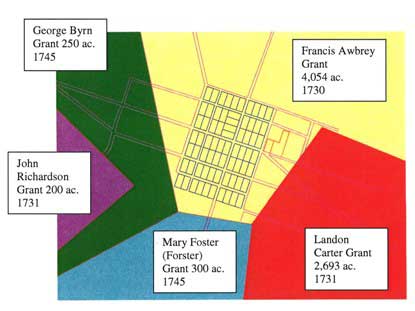
Original Land Grants at Future Site of Leesburg Drawn by Debbie Robison
Neither the Carolina Road (now approximately Route
15), nor the Shenandoah Road
(now approximately Route 7) were mentioned in the early grants or surveys of
land surrounding the future site of Leesburg. Thomas Scharf,
a historian in Western Maryland in the 19th
century, settled on 1740 as the date for the inception of the Carolina Road.[5] It has been suggested that the Shenandoah Road may
have been a path used by Europeans as early as 1699, though it likely didn’t
become a road until after a tobacco warehouse was established on Hunting Creek in
1732.[6]
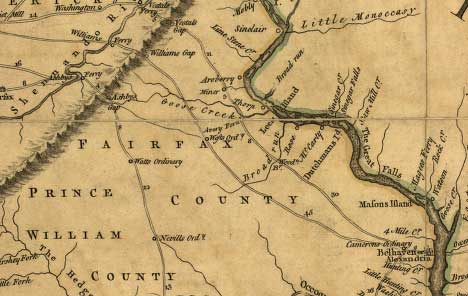
The road was certainly in existence by 1754, when Capt. John Dalrymple left for England and updated the 1751 Joshua
Fry and Peter Jefferson map. Nicholas Minor’s name was written on the map near
the future site of Leesburg. Minor may have been operating an ordinary (tavern)
in the area, though this is under debate by historians.
Portion of the 1755 Fry and Jefferson Map as Updated by John Dalrymple Image Courtesy Library of Congress, Geography and Map Division
|
|
|
As the French increased their
efforts in the Ohio Valley to gain control from the British of the North
American continent between Canada
and Louisiana, Virginia Governor Dinwiddie
appointed George Washington, a major in the Virginia militia, to deliver a message to
the French at Fort Le Boeuf demanding they relinquish
large areas of land. In the autumn of 1753, Washington
traveled to the fort through western Fairfax
County , land that would become Loudoun County when the county was formed in
1757. In early April 1754, Washington again
traveled from Alexandria with part of a regiment
of Virginia
frontiersmen to the northwest. After reaching Great Meadows, he learned of a
party of French soldiers nearby. Washington
successfully fought a skirmish with the French, after which he retreated to
Great Meadows and built Fort
Necessity . On July 3,
1754, a large force of French and Indians attacked Fort
Necessity , resulting in Washington ’s surrender and subsequent march back to Virginia .
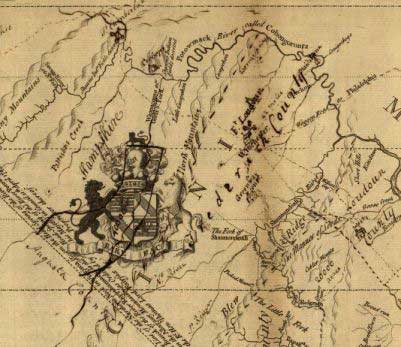
Portion of A survey of the Northern Neck, being the lands belonging to the Rt. Honorable Thomas Lord Fairfax..., modified after 1757 Image Courtesy Library of Congress, Geography and Map Division
Following Washington’s
defeat, the French inspired Indian attacks throughout the frontier, terrorizing settlers, many of whom fled eastward over the Blue Ridge into the Piedmont counties.
Fear of attack continued until
the British gained control of
Fort
Duquesne
in November
1758. The victory, which coincided with the capture of other forts, motivated
many Indians to desert the French cause.
Nicholas Minor, living during the
conflict near present day Leesburg, became a captain in the Fairfax militia in 1753. The Town of Leesburg was formed in
1758 prior to the calming of fear of Indian attacks. Local legend maintains
that a fort was constructed by the militia at the Leesburg site for protection
of area inhabitants.[7] Though
not discounting the possibility of a fort, a review of local deeds, George Washington’s letters, and period maps
was conducted; however, there was no indication discovered in these written
records of a fort in area.
|
|
|
In 1741, John Awbrey,
son of Francis Awbrey, was devised about 326 acres of
land in his father’s will. John Awbrey had already
been living on the land at the time. Three years later, at John Awbrey’s death, the land was sold by Mary Awbrey, his widow, to pay his debts.[8]
John Carlyle, an Alexandria
merchant, became the purchaser in 1745.[9]
His title to the land was confirmed in May 1757 when a new deed was recorded
between Carlyle and Mary Awbrey’s new husband, John
Mills.[10]
Just prior to the formation of
the town of Leesburg(h), Carlyle sold the land to his cousin-in-law, Nicholas
Minor, Jr.[11]
The town of Leesburg, originally known as George Town, was laid out in a
gridiron plan of one-half acre lots about the time that Loudoun County was
formed in 1757.
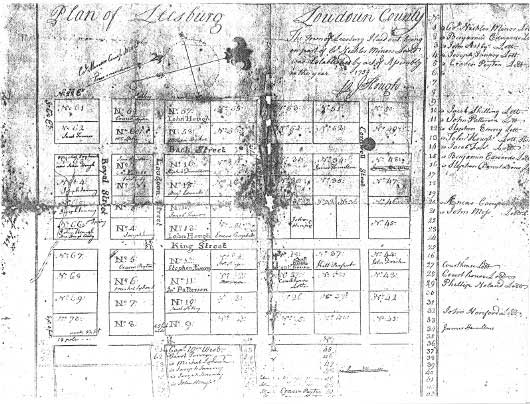
Leesburg Town Plat Courtesy the Thomas Balch Library, Leesburg, VA
In November 1757, representing
the Inhabitants of George Town,
Nicholas Minor petitioned the Loudoun
County Court to open the roads leading from Alexandria and Noland’s Ferry (north of Leesburg on the Potomac River) so that the roads passed through the town.[12]
The first lot was sold in
February 1758. In addition to the lots within the town, Minor sold
irregularly-shaped lots surrounding the town south of Market Street. The town was likely
formally created by the Virginia General Assembly circa October 1758.[13]
The land surrounding the town
north of Market Street,
comprising 258 ½ acres, was sold to John Patterson in 1767.[14]
John Patterson gave one-half interest in the parcel to his brother and business
partner, Fleming Patterson. They carried on the business of trade and
merchandising in Leesburg under the firm of John and Fleming Patterson
Merchant. In the course of operating their business, they became considerably
indebted to Henry McCabe. After John Fleming’s death, the Loudoun County Court,
in a chancery case in November 1771, ordered the real estate to be sold to pay
debts. Henry McCabe was the highest bidder.[15]
|
|
[1] Northern
Neck Grant Book B, p. 151 (NN B:151), Jacob Binks, 145 acres, 17 October 1728; NN
B:157, Isaac Lasswell, 198 acres, 21 October 1728; NN B:159, Midleton Shaw, 188
acres, 22 October 1728; NN B:218, Jacob Lasswell, 140 acres, 15 March 1728/1729; NN B:153, William Matthews, 150 acres, 18 October 1728
[2] In 1738
Ann Mason purchased Francis Awbrey’s 4,054 acre
grant, less about 236 acres retained by John Awbrey. (Prince William Deed Book B, p. 9 (PWDB B:9). She purchased a portion
of this land, i.e. 645 acres, from Thomas Johns in 1747. (Fairfax Deed Book B, p. 250 (FXDB B(logical book number
2):250). In the 1750s, prior to the formation of the Town of Leesburg,
Mason divided a portion of the land into leaseholds of between 100 and 150
acres each. FXDB
C(3):591 lease to John Thomas, 150 acres, 18 Apr 1753; FXDB C(3):597 lease
to Mary Jennings, 110 acres (ten acres for flaxland), 18 Apr 1753; FXDB
C(3):603 lease to Samuel Mobbily, 100 acres, 18 Apr
1753; FXDB C(3):609 lease to Hugh Foutch,
150 acres, 18 Apl 1753; FXDB
C(3):615, lease to Christopher Winsor, 100 acres, 18 Apl 1753; FXDB D(4):266, lease to
Christopher Perfect, 150 acres, 2 Jun 1756. George Carter, who inherited the
Landon Carter grant, leased parcels near Leesburg. Loudoun Deed Book T, p. 182
(LNDB T:182) Carter lease to
Patrick Cavans, 47 ¾ acres, in 1792; LNDB R:202 Carter lease to Samuel Love, 45 acres, in 1788; LNDB R:198 Carter lease to Samuel Love, 130 acres, in 1788.
[3] NN C:102, Francis Awbrey grant of 4,054 acres, 11 Feb 1730.
[4] NN C:172, Landon Carter grant of
2,693 acres, 29 Jun 1731.
[6] Fairfax Harrison, Landmarks of Old Prince
William, Volumes I & II, 2nd
Reprint ed., Gateway Press, Baltimore, 1987, p.480.
[7] Harrison
Williams, Legends of Loudoun, Garrett
& Massie, Inc., Richmond, 1938, p.107; Quoting from Messrs. Patrick A. Deck
and Henry Heaton’s 1926 book titled Economic
and Social Survey of Loudoun County.
[8] Fairfax
County Will
Book (FX WB) A1(650):60, 17 May 1744.
[9] Fairfax County
Deed Book (FX DB) A(1):400, 17 Jun 1745.
[10] FX DB D1(4):417, 17 May 1757.
[11] Loudoun
County Deed Book (LN
DB) A:113, 08 Sep 1757.
[12] Loudoun County
Order Book (LN
OB) A:52; 09 Nov
1757.
[13] John T.
Phillips, II, The Historian’s Guide to Loudoun County,
Vol. 1, Colonial Laws of Virginia
and County Court Orders 1757-1766, Goose Creek
Productions, Leesburg & Middleburg Virginia, 1996, p. 337.
[14] LN DB F:275, 18 Sep 1767.
[15] LN DB L:114, 21 Feb 1775.
|