Biography
Garges Family of Anandale Farm: How a family who built up a village lost it all by opposing secession
Annandale, Fairfax County, Virginia

The story of William Garges and his son John Henry Garges, Pennsylvania-born settlers who founded the village of Annandale, Virginia, and the toll their staunch Unionist views took on their property and livelihood during the Civil War.
Development of Anandale
In 1820 William Garges, a former merchant from Bucks County, Pennsylvania, purchased 134 acres at the intersection of Backlick Road and the Little River Turnpike.1 He had a house built that same year for his family. At the time, he and his wife, Susan, had at least six children whose ages ranged from infant to 12 years old.2
The Garges farm was called Anandale, which gave the village its name. Beginning around the time of the Civil War, the name was more commonly spelled Annandale.
The following images depict the bounds of the land purchased by William Garges in 1820. The boundary is shown on aerial images from 1949 and 2002.

1949 Background Image Courtesy USGS

2002 Background Image Courtesy USGS
The land was originally part of the large Ravensworth tract. Following is a portion of a survey prepared ca. 1792 that depicts roads that existed at the time.3 It is interesting to note that Little River Turnpike had not been constructed yet and Backlick Road continued in a straight course to what is now known as Annandale Road.
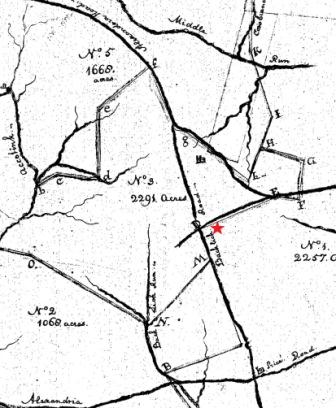
Ravensworth Plat, Red star indicates location of Garges farm. Plat image courtesy Fairfax County Circuit Court Archives
The Garges home was located near the intersection of Backlick Road and Little River Turnpike (Now the intersection of Columbia Pike and Little River Turnpike). The family blacksmith shop was located near the house.4 Garges farmed his land and cultivated a wide variety of fruit trees.5 In 1837 he established the Anandale post office and was appointed postmaster.6 Four years later he placed an advertisement in the Alexandria Gazette in an effort to sell Anandale Farm at a private sale, though he did not succeed.7 Fortunately, he advertised that his land was named Anandale Farm, thus documenting the name of the farm.
NOTICE. I WILL sell at private sale, my ANANDALE FARM, in Fairfax County, Va., 7 1/2 miles from Alexandria, containing 133 acres, on the Little River Turnpike. WM GARGES
John Henry Garges, his son, purchased a small triangular-shaped lot at the intersection of Backlick Road and Little River Turnpike from his father in 1843.8 This land included the house where his father resided and the blacksmith shop. John Henry Garges established a plough and wagon factory at Anandale. The factory was destroyed by fire in 1845, along with valuable timber, tools, and several new wagons.9 He evidently rebuilt his business. The 1850 industry non-population census indicates that Garges was in the blacksmith and wheelwright business making wagons, horseshoes, and "farm work."10
John Henry Garges expanded his business enterprises in Annandale in 1854. In September he purchased 8 1/2 acres on the south side of the turnpike.11 His 1904 obituary states that he conducted a hotel, store, and livery stable at Anandale. The location of the 8 1/2 acres is indicated on the aerial photos below by a red border.12
He also purchased a one-acre lot with James Benton on the Little River Turnpike where the Manassas Gap Rail Road was going to cross the turnpike.13 Garges and Benton were contractors for several sections of the Independent Line of the Manassas Gap Rail Road and built a saw mill on this lot for use with the railroad construction.14 Financial constraints resulted in the Manassas Gap Rail Road Company abandoning the unfinished Independent Line. The location of the one-acre lot is indicated on the aerial photos below by a magenta border.

1949 Background Image Courtesy USGS
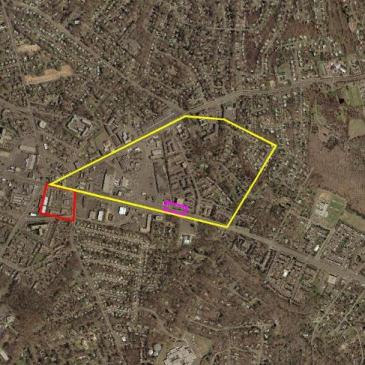
2002 Background Image Courtesy USGS
William Garges provided land for the Anandale Methodist Episcopal Church.15 The Anandale Chapel was dedicated in December 1846.16 There is a gravemarker in the cemetery for William Garges' wife, Susan, who died in 1828, years before the church was constructed. William Garges died in 1855. In the fall of 1863 during the Civil War, possession of the church was taken by General Blenker and Colonel Lowell who used the church as quarters for a while before dismantling it and using the materials and contents to construct winter quarters.17 The church was reconstructed after the war.
Impact of Civil War
John Henry Garges was detrimentally impacted by his strong pro-union sentiments at the time of the Civil War. He was a devoted republican who was arrested in 1859 for circulating, through the post office at Anandale, Hinton Helper's book The Impending Crisis of the South, which advanced the abolitionist theory that slavery hurt the economic prospects of the majority of southern whites. Distributing the book was viewed as an act of sedition. James W. Jackson, an outspoken southern aggressor who killed Colonel Ellsworth at Marshall House in Alexandria at the start of the war, notified the newspaper of Garges' arrest.18 Jackson, along with Joseph Edward Monroe, also arrested Garges' neighbor, Thomas Crux, when Crux was trying to get away. Crux made it as far as the Long Bridge.19
Most of Garges' neighbors favored secession. Garges was called a Black Republican due to his views, which he expressed to some of his neighbors in an effort to convince them to vote for the Union.20

Map of northeastern Virginia...by order of McDowell, 1862, Image Courtesy Library of Congress
Garges, along with a few of his near neighbors, voted against secession at the Anandale precinct.21 The Anandale precinct elections were held on Garges' porch. Although Garges was one of the election commissioners, citizens still found it difficult to vote against secession. A fellow commissioner, George Burke, reportedly influenced the elections through the use of intimidation.22
Garges moved to Washington D.C. five days after voting for the ordinance of secession, though for a time his family remained.23 A neighbor, Ambrose Cock, Jr., had, to a certain extent, supervision of some of Garges' property, and his father, Ambrose Cock, Sr., looked after Garges' family.24 John Henry Garges and his wife Martha had nine children. The youngest was less than a year old when his father was forced to flee to Washington, D. C.25 Garges filed a petition with Congress for financial relief for losses he sustained from Confederates who destroyed his property because of his pro-union stance.26 After the war, his land at Annandale was sold off to pay creditors who filed suit against him.27 Some of his creditors had voted for secession, yet Garges remained liable for debts the war made impossible to pay.
Bibliography
Robert Morgan Moxham, Annandale, Virginia A Brief History, Estella K. Bryans-Munson, Editor, Fairfax County History Commission, Fairfax, 1992.
Footnotes
-
Fairfax County Deed Book (FX DB) R2(44)357, 06 May 1820. ↩
-
Fairfax County Land Tax Ledger of 1821. Ledger indicates a house value of $528. The following year there is a notation that $3.95 per acre was added to the assessment due to improvements. Since this works out to be about $528, there must not have been any improvements previously. Genealogy is based on census data. ↩
-
FX DB A2(27)186, Surveyed ca. December 1792 and recorded 14 July 1797. ↩
-
FX DB J3(62)221, 12 Aug 1843. Deed notes location of smith's shop and the approximate location of the house. ↩
-
William Garges, "A Valuable Farm for Sale," Alexandria Gazette, 17 Aug 1853, p. 2. ↩
-
Record of Appointment of Postmasters, 1832–Sept 20, 1971, Virginia Post Offices, Microfilm, Virginia Room, Fairfax County Public Library, Fairfax, VA. ↩
-
Alexandria Gazette, 17 Dec 1841, p. 3. ↩
-
FX DB J3(62)221, 12 Aug 1843. ↩
-
Alexandria Gazette, 05 Nov 1845, p. 2. ↩
-
Fairfax County Industry Non-population Census, 1850, microfilm, Virginia Room, Fairfax County Public Library, Fairfax, VA. ↩
-
FX DB V3(74)43, 25 Sep 1854. ↩
-
Evening Star (Washington, DC), 02 Nov 1904, p. 5. ↩
-
FX DB W3(75)413, 22 Nov 1854. ↩
-
Alexandria Gazette, February 26, 1855, p. 3. ↩
-
FX DB L3(64)294, 01 Oct 1846. ↩
-
Alexandria Gazette, December 15, 1846, p. 2. ↩
-
Congressional Court of Claims, No. 13626, United States Congress, Congressional Edition, Vol. 6597, Document 519, Trustees of the Methodist Episcopal Church, South, of Annandale, VA, as viewed on Google Books. ↩
-
Alexandria Gazette, December 22, 1859, p. 3. ↩
-
Anonymous, Life of James W. Jackson, The Alexandria Hero, The Slayer of Ellsworth, West & Johnston, Richmond, 1862, pp. 22, 23. As viewed on Internet Archive http://archive.org/index.php ↩
-
John H. Garges deposition, Southern Claims Commission, Ambrose Cock Sr. petition number 2011, as viewed on www.ancestry.com. ↩
-
The Ordinance of Secession, list of votes by precinct, Fairfax County Circuit Court historical records, Fairfax, Virginia, viewed online at http://www.fairfaxcounty.gov/courts/circuit/pdf/ordinance-of-secession.pdf on November 27, 2012. ↩
-
John H. Garges deposition, Southern Claims Commission, John H. Sweeney petition number 2007, as viewed on www.ancestry.com. ↩
-
John H. Garges deposition, Southern Claims Commission, John H. Sweeney petition number 2007, as viewed on www.ancestry.com. Also, John H. Garges deposition, Southern Claims Commission, Ambrose Cock Sr. petition number 2011, as viewed on www.ancestry.com. ↩
-
John H. Garges deposition, Southern Claims Commission, Ambrose Cock Sr. petition number 2011, as viewed on www.ancestry.com. ↩
-
Federal Census of 1860. ↩
-
Edward McPherson, Digested Summary and Alphabetical List of Private Claims, Washington, Government Printing Office, 1873, p. 167. Viewed on Google Books. ↩
-
Alexandria Gazette, 17 Aug 1867, p. 2; Also Alexandria Gazette, 17 Mar 1871, p. 3. ↩